

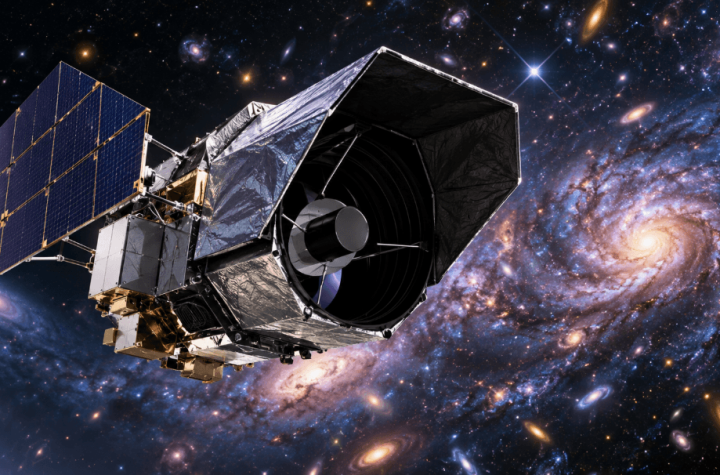
NASA’s Nancy Grace Roman Space Telescope has successfully powered up its 300-megapixel Wide Field Instrument, marking a major milestone as the observatory moves closer to beginning its sweeping survey of the universe.
The infrared camera is designed to capture exceptionally large areas of the sky while maintaining sharp detail, giving astronomers a powerful tool for studying distant planets, dark energy and the distribution of matter across the cosmos.
Roman’s 300-Megapixel Camera Comes Online
The Wide Field Instrument, or WFI, combines a broad field of view with image sharpness comparable to observatories such as NASA’s Hubble Space Telescope. Each image will cover an area of sky larger than the apparent size of the full moon.
This combination of scale and detail will allow scientists to conduct extensive surveys of the universe more efficiently. Roman will search for planets beyond the solar system, investigate major questions surrounding dark energy and map how matter is distributed across vast cosmic distances.
The enormous datasets produced by the telescope are also expected to support many additional areas of astronomical research.
“After years of effort to build and test the instrument on the ground, we now have confirmation that it is operational in space. This is a huge milestone for the team at Goddard, our industry teams at BAE Systems, Inc. and Teledyne, and our science centers,” said Josh Schlieder, the Wide Field Instrument scientist at NASA’s Goddard Space Flight Center in Greenbelt, Maryland. “There is much to do, but we are on our way to groundbreaking science.”
Roman’s Coronagraph Instrument, designed to demonstrate technologies for directly observing planets around other stars, has also completed an initial series of digital, electronic and mechanical checks.
Cooling Roman’s Infrared Detectors
Before engineers could fully activate the Wide Field Instrument, it remained idle for 10 days to allow the system to dry out and undergo decontamination.
During that period, the detectors were maintained at approximately minus 85 degrees Fahrenheit, or minus 65 degrees Celsius. Although extremely cold by everyday standards, that temperature was relatively warm compared with the instrument’s final operating conditions.
Engineers then switched off the instrument heater and allowed the WFI to cool to minus 225 degrees Fahrenheit, or minus 143 degrees Celsius.
After reaching that temperature, the team activated Roman’s 18 infrared detectors. Together, the detectors have a light-sensitive area roughly comparable to the size of a laptop screen.
Engineers subsequently activated the instrument’s calibration system and began sending test data through the WFI and back to teams on Earth.
Filters, Prisms and Focus Mechanism Tested
Engineers also tested the WFI’s element wheel, which contains filters, prisms and other optical components that determine which wavelengths of light reach the detectors.
The system can separate light from cosmic objects into individual colors, providing scientists with information that can help reveal their physical characteristics. The test marked the first time the mechanism had operated in a weightless environment.
The team then tested the WFI’s focusing mechanism and confirmed that it was functioning properly.
Accurate focusing will be essential throughout Roman’s mission because the observatory is expected to capture hundreds of thousands of images as it surveys the sky.
Roman Continues Journey Toward L2
Throughout the instrument tests, the infrared detectors continued cooling until they reached their final operating temperature of approximately minus 300 degrees Fahrenheit, or minus 183 degrees Celsius.
Roman is undergoing a months-long commissioning process while traveling roughly one million miles toward the second Lagrange point, known as L2. The location provides a stable environment for space observatories carrying out sensitive astronomical observations.
With its Wide Field Instrument now powered up and key systems successfully passing initial checks, Roman is moving closer to beginning the large-scale surveys that will help scientists investigate planets, cosmic structure and some of the biggest unanswered questions about the universe.

William Faulkner is a contributor to Columbuspost.com, covering a broad range of topics including news, politics, business, technology, sports, entertainment, and lifestyle. He focuses on delivering clear, accurate reporting and useful information that helps readers stay informed about current events and developments. His work highlights stories that matter to local and wider communities, with an emphasis on relevance, clarity, and providing readers with a balanced understanding of the issues shaping everyday life.


More Stories
Citizen Scientists Revived NASA’s Long-Retired ISEE-3 Spacecraft
Magnetic Bacterium Extends Worm Lifespan by 43% in Anti-Aging Study
Princeton Fusion Spinout Scales Flat Superconducting Magnets for Commercial Power Plants